How to design a customer journey map for a loyalty program? | 5BONSAI
Discover the key stages of designing a Customer Journey Map and learn how to use them to improve the effectiveness of your loyalty program.
October 28, 2026
Loyalty programs fail to generate profits for one simple reason: companies design them in cold, impersonal Excel spreadsheets, forgetting about the people behind the numbers. But loyalty isn't about boring terms and conditions or cheap plastic gifts from a rewards catalog. It's about emotions that make customers choose your brand—not because they have to, but because they genuinely feel good about being your customer.
Adobe's data supports this: companies that actively manage the customer journey and invest in customer experience achieve nearly 25% year-over-year revenue growth.
What is a Customer Journey Map in a loyalty program?
A Customer Journey Map for a loyalty program is a visual representation of the entire relationship between a customer, a brand, and its loyalty program. It illustrates the different stages a customer goes through: from first discovering the program and signing up to using benefits, becoming a regular participant, or eventually leaving the program.
Such a map helps answer several key questions. What motivates customers to join? What might discourage them right from the start? Do they understand how the program works? Do they see real value in the rewards? Does the brand remind them of the benefits at the right moment?
Customers don't just want to collect points. They want to feel that participating is worthwhile, easy, and offers something they actually need. A Customer Journey Map allows you to intentionally design that experience rather than simply hoping customers will discover the program's value on their own.
How to design a Customer Journey Map step by step?
Define the goal of your loyalty program
The first step isn't drawing the map. It's understanding why your loyalty program should exist in the first place. You'll design a different customer journey for a brand looking to increase purchase frequency, a company trying to reduce customer churn, or an e-commerce business aiming to increase average order value.
Your goal should be specific. It might be increasing the number of returning customers, re-engaging customers who haven't made a purchase in a while, increasing average order value, or building a community around your brand. Only then can you determine which customer behaviors you want to encourage at each stage of the journey. A clearly defined goal gives structure to the entire map. It helps you identify the most important touchpoints and decide which messages should appear at specific moments.
Define your customer personas
Not every customer joins a loyalty program for the same reason. Some are looking for discounts, others value convenience, while others want to feel special. That's why, before creating your map, it's worth developing customer personas—simplified profiles of your most important customer segments.
For example, in an online store, one persona might represent an occasional shopper who only makes purchases during promotions. Another might describe a loyal customer who values early access to new products. A third could represent someone who chooses a brand because of its values, such as sustainability, quality, or local production.
Customer personas help you avoid designing a loyalty program "for everyone." Instead, you create experiences for specific people with different needs, concerns, and motivations.
Map out every stage of the customer journey
A Customer Journey Map should cover the entire customer journey, not just the moment of purchase. For a loyalty program, it's worth including at least several fundamental stages:
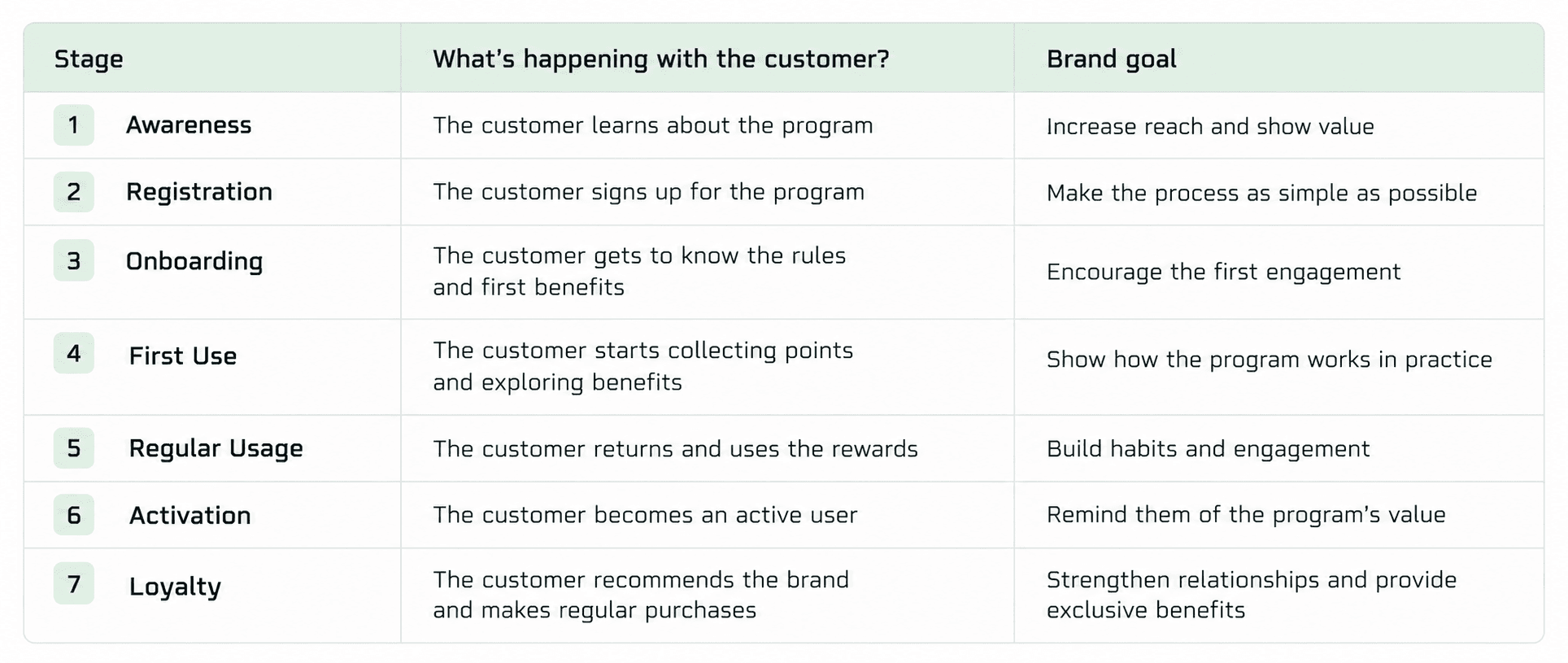
This approach helps you identify when customers need information, when they need emotional encouragement, and when a specific sales incentive can motivate them to make a purchase.
Identify all brand touchpoints
Touchpoints are all the places where customers interact with your loyalty program. These might include your website, mobile app, email, SMS, push notifications, advertisements, customer account dashboard, customer service, physical stores, or post-purchase messages.
At this stage, it's important to check whether your communication is consistent. If a customer sees a banner promoting the loyalty program but lands on a complicated terms and conditions page after clicking, the experience immediately suffers. If customers earn points but don't know how many more they need to unlock a reward, their motivation decreases. If the brand doesn't remind them about available benefits, the program gradually loses its relevance.
Every touchpoint should serve a clear purpose. One should spark interest, another should explain the benefits, a third should encourage action, and the next should maintain engagement.
Describe customer needs, emotions, and barriers
The greatest value of a Customer Journey Map is that it shows not only what customers do but also how they feel. At every stage, it's worth asking three questions: What does the customer need? How might they feel? What could stop them from moving forward?
During registration, customers may need simplicity. If the sign-up form is too long, they may abandon the process.
During regular participation, they need reminders and a sense of progress. If they can't see that they're getting closer to a reward, they lose motivation. These barriers often determine how effective a loyalty program will be. Sometimes, simply shortening the registration process, simplifying a message, or adding a notification about the points needed to unlock the next reward can significantly increase participant engagement.
Modern customer journey trends: Gamification and Geofencing
To ensure that the customer journey map reflects modern consumer habits, we need to integrate technologies that engage users in real time at key touchpoints.
Gamification – how to maintain customer engagement?
Gamification involves introducing game-like elements into the shopping experience, turning the process of collecting points into an exciting challenge. Traditional point collection systems, such as "Spend £10, earn 1 point," quickly become boring.
By incorporating progress bars, badges, time-limited challenges (e.g., "Make 3 purchases this month to unlock a bonus"), or tiered loyalty levels into the customer journey, you provide customers with psychological rewards and motivation to take action.
Gamification works particularly well during the regular participation stage, maintaining high engagement and preventing the natural decline in program activity over time.
Geofencing – the perfect touchpoint in an omnichannel strategy
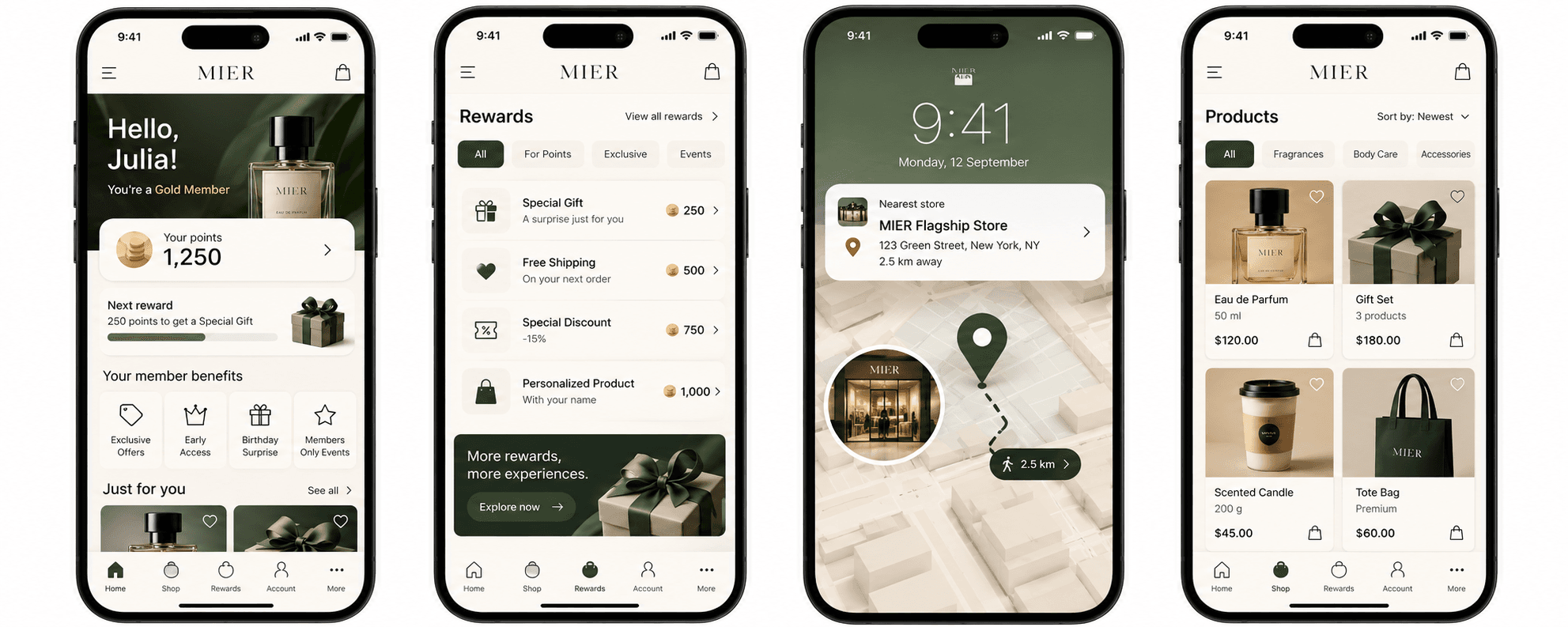
Geofencing is a GPS-based location technology that allows brands to send personalized push notifications to customers' smartphones when they are near a physical store.
A well-designed Customer Journey Map (CJM) enables real-time interactions. For example, when a customer walks through a shopping mall, the automation system detects their presence and sends a short message:
"You have 500 points in your account. Visit our store just 50 meters away and claim a free coffee."
This way, technology helps drive conversions at the exact moment a purchase impulse arises.
What data should you use to create a Customer Journey Map?
A Customer Journey Map must be based on facts, not assumptions. Only reliable data can reveal the actual behavior of loyalty program participants: where they actively engage and which touchpoints need improvement.
To combine statistics with customer emotions, it's worth dividing the collected information into three categories:
Quantitative data (What do customers do?)
Statistics from CRM systems and Marketing Automation platforms. Analyze purchase history, transaction frequency, mobile app analytics, and open and click-through rates (OR/CTR) for emails, SMS messages, and push notifications.
Qualitative data (How do customers feel?)
Insights into why customers decide to leave. You can gather them from customer service inquiries, reviews on the App Store and Google Play, and direct customer satisfaction surveys (NPS).
Zero-party data (What do customers expect?)
In the era of cookie restrictions, this is one of the most valuable sources of information for customer journey mapping. Zero-party data refers to information that customers consciously and voluntarily share with a brand, for example, through short in-app quizzes, providing their birthday, or specifying shopping preferences in exchange for additional loyalty points.
How to interpret this data on the customer journey map?
Combining these data sources allows you to quickly identify weak points in the customer journey:
Low engagement after registration: If customers sign up for the program in large numbers but fail to take their first action, the problem likely lies in onboarding. The welcome communication may be unclear, or there may be no simple incentive encouraging customers to get started.
Low reward redemption rate: If users collect points but don't redeem them, take a closer look at your rewards catalog.
Zero-party data insights: Zero-party data can help you determine whether point thresholds are too high or whether the rewards themselves fail to match customers' actual preferences.
This approach transforms a Customer Journey Map into a practical tool for improving customer retention, customer lifetime value (CLV), and the overall effectiveness of your loyalty program.
Common mistakes when creating a Customer Journey Map – what should you watch out for?
Avoid common pitfalls that can ruin the customer experience, even when everything works perfectly from a technical perspective:
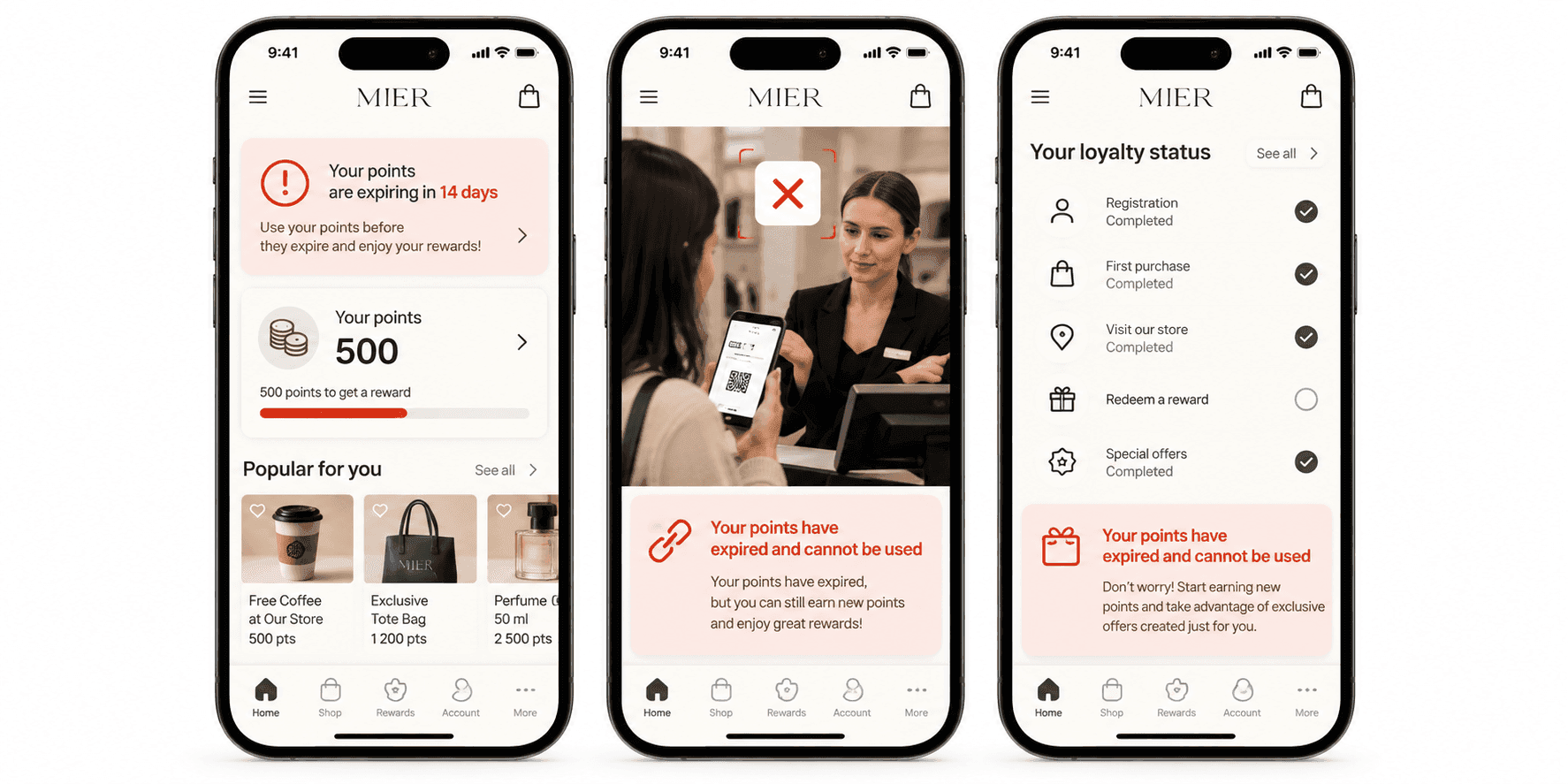
Failing to communicate point expiration
If you don't schedule an automatic reminder about expiring points (e.g., 14 days before the expiration date), customers may suddenly discover that their points balance has dropped to zero. They'll feel frustrated and may simply switch to a competitor.
Lack of consistency between online and offline channels
When a sales associate in a physical store cannot check a customer's loyalty points from their mobile app, it creates a frustrating experience that undermines trust in the brand.
Treating the map as a one-time project
Customer needs change, and the market continues to evolve. Your Customer Journey Map should evolve alongside your business. It's worth reviewing it and evaluating key touchpoints at least once a year.
Remember!
A Customer Journey Map helps you see your loyalty program through your customers' eyes: from their first interaction with your brand, through registration and onboarding, to regularly enjoying the program's benefits.
This matters because customer loyalty has a direct impact on sales. According to data cited by McKinsey, loyal customers are 64% more likely to make purchases more frequently and 31% more likely to pay a higher price.
FAQ
Frequently asked questions
Yes, a Customer Journey Map is useful even for a small loyalty program, as it helps quickly identify points where customers might lose interest. It doesn't have to be an extensive strategic document. To start, a simple map showing how customers discover the program, how they sign up, when they receive their first benefit, and what encourages them to make another purchase is enough.
Customer Journey Map as the foundation of an effective loyalty program
Creating a Customer Journey Map is a strategic tool that helps you streamline communication, implement modern technologies such as geofencing and gamification, and most importantly, truly address your customers' needs. When you focus on their emotions and eliminate friction points, your loyalty program will start generating profits, and customers will be less likely to switch to competitors.
Do you already have an idea for a customer loyalty club but want to make sure that the registration, onboarding, and reward processes are planned perfectly?
Let's talk about your strategy and map out your customers' journey together!
Blog
See also

How to create a loyalty program: 5 key steps | 5BONSAI
Learn how to design a loyalty program that engages customers, increases purchase frequency, and builds long-term relationships with your brand.

Omnichannel marketing in brand strategy | 5BONSAI
Learn how to leverage omnichannel marketing to build consistent communication, better customer experiences, and a stronger brand.